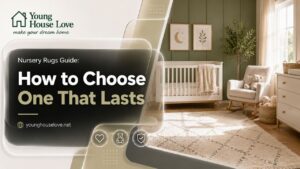
I spent three weekends last spring helping my sister redo her son’s nursery, and the rug turned out to be the hardest decision in the entire room. Harder than the crib. Harder than the paint color. She’d already bought two rugs before we even started — one shed fibers everywhere, the other looked gorgeous in photos and felt like sandpaper under a crawling baby’s knees. That’s when it hit me how little honest information exists about nursery rugs, considering how much time a baby actually spends on the floor.
Most articles about rugs for nursery rooms read like they were written by someone who has never had spit-up, applesauce, and glitter glue hit the same square foot of flooring in one afternoon. This guide is different. It’s built from actual trial and error, conversations with a few interior designers who specialize in children’s spaces, and a fair amount of research into textile safety standards that most retailers never bother to mention.
By the end, you’ll know exactly what to look for in baby rugs, how a proper nursery rug differs from a regular living room rug, and how to pick something that survives the toddler years without needing to be replaced twice.
Why the Floor Matters More Than People Think
Babies live at floor level for the first two years of their lives. Tummy time, crawling, first steps, nap-time meltdowns — nearly all of it happens on the rug, not the crib. A hard, cold, or chemically treated surface isn’t just uncomfortable. It affects how much time a baby actually spends exploring and moving, which pediatric occupational therapists will tell you matters for motor development.
That’s the practical case for a good nursery rug. There’s also a sensory one. Texture is one of the first things infants learn to distinguish, and a soft, breathable rug gives them something safe to touch, chew (yes, it happens), and eventually stand on while holding the crib rail. Cheap synthetic rugs off-gas volatile organic compounds for weeks after unboxing, which is the last thing you want in a room where a baby breathes for twelve hours a night.
What Actually Makes a Rug Nursery-Safe
Not every soft rug qualifies as safe for a nursery, even if the packaging says “kid friendly” in big letters. Here’s what I’d actually check before buying.
Material
Natural fibers like organic cotton, wool, and jute tend to outperform synthetic blends in nurseries because they’re naturally flame-resistant, hypoallergenic in most cases, and don’t rely on chemical treatments to pass safety tests. Wool in particular resists dust mites, which matters if your baby has any respiratory sensitivity. That said, wool can be pricier and harder to spot-clean, so it’s a trade-off worth thinking through before you commit.
Cotton rugs are the middle ground — soft, breathable, and usually machine washable, though they wear down faster under heavy foot traffic than wool.
Certifications Worth Looking For
- OEKO-TEX Standard 100 — confirms the rug was tested for harmful substances
- GOTS (Global Organic Textile Standard) — relevant if the rug claims to be organic cotton
- CertiPUR-US — applies to any foam padding or backing underneath the rug
- Greenguard Gold — indicates low chemical emissions, useful for enclosed nursery spaces
If a listing doesn’t mention any certification at all, that’s usually a sign the rug was manufactured to a price point rather than a safety standard.
Pile Height and Backing
Low-pile rugs are easier to keep clean and safer for crawling babies who might trip over a thick, shaggy weave once they start pulling up to stand. Look for a non-slip backing too — natural rubber is preferable to PVC-based backing, which can also off-gas.
Nursery Rug vs. Standard Area Rug: What’s Actually Different
People often assume any soft rug will do the job. It won’t. Here’s a side-by-side look at how a dedicated nursery rug compares to a generic living room area rug.
| Feature | Nursery Rug | Standard Area Rug |
|---|---|---|
| Material safety testing | Usually certified (OEKO-TEX, GOTS) | Rarely certified |
| Pile height | Low to medium | Often high-pile or shag |
| Cleaning method | Machine washable or spot-clean friendly | Often dry-clean only |
| Chemical treatments | Minimal, low-VOC | May include stain guards, flame retardants |
| Edge/backing safety | Non-slip, rounded corners common | Standard backing, sharp corners |
| Price range | Mid-range, function-driven | Wide range, design-driven |
This is exactly why searching specifically for rugs for nursery spaces, rather than just browsing generic home decor rugs, tends to get better results. The design world and the baby-safety world overlap, but they aren’t the same industry.
Machine Washable Rugs: The Feature Parents Actually Use
If there’s one lesson from every parent I talked to while researching this piece, it’s this: buy washable or regret it within a month. A tumble machine washable rug kid & pet friendly by design solves the single biggest complaint about nursery flooring — the fact that bodily fluids, food, and paint happen constantly and rarely give you warning.
These rugs are typically made from low-pile, quick-dry synthetic or blended fibers that can go into a standard washing machine (sometimes a large-capacity one) and come out looking new. A handful of brands, including Ruggable, Lorena Canals, and Tumble, built their entire business models around this exact problem. Look specifically for rugs described as kid friendly rugs with a washable cover system, since many of these use a two-piece design — a grippy pad underneath and a removable, washable top layer.
The downside worth mentioning honestly: washable rugs sometimes shrink slightly after repeated washes, and the colors can fade faster than a wool rug that’s dry-cleaned occasionally. For a nursery, though, that trade-off is almost always worth it.
Matching the Rug to the Room and the Age
A rug that works for a newborn’s nursery isn’t necessarily what you’ll want once that child turns four and starts hosting Lego battles on the floor. It helps to think in stages.
Newborn to Age 2: Soft, Simple, Washable
At this stage, baby rugs need to prioritize softness and hygiene above all else. Neutral or gentle patterns work well because a newborn’s visual system isn’t developed enough to appreciate bold graphics yet, and you’ll want something calming for late-night feedings under low light. This is peak nursery rug territory — think plush, low-pile, and easy to wipe down.
Ages 2 to 5: Durable and Playful
Once a toddler is mobile and opinionated about everything, kids rugs need to hold up to spills, crayon incidents, and the occasional juice box catastrophe. This is also when kids room rugs start doubling as a play surface — a soft base for building blocks, puzzles, and pretend play. Round rugs work surprisingly well in this stage because they eliminate sharp corners kids run into.
Ages 5 and Up: Personality and Durability
By elementary school age, kids have real opinions about their space. Childrens bedroom rugs at this stage often reflect a theme — space, dinosaurs, sports, whatever the current obsession happens to be. A well-chosen childrens bedroom rug can genuinely make a room feel like it belongs to that specific kid rather than a generic catalog photo.
If you’re shopping specifically for a son’s space, a boys room rug with structured patterns — stripes, geometric shapes, sports motifs — tends to age better than something overly cartoonish that a ten-year-old will find embarrassing in two years. Practical tip: pick something the kid will still like at age nine, not just age five.
For families furnishing multiple rooms, it’s worth browsing rugs for childrens rooms as a category rather than shopping room-by-room, since buying in a coordinated style (even in different colors) makes the whole upstairs feel intentional instead of thrown together. The same logic applies whether you’re picking out a single rug childrens room design or outfitting rugs for childrens bedrooms across two or three kids at once.
Playroom Rugs: Built for a Different Kind of Chaos
A playroom takes more abuse than any other room in the house, full stop. This is where a dedicated playroom rug earns its keep. Unlike a bedroom rug, a playroom rug needs to survive:
- Marker and paint accidents (regularly)
- Food and snack spills
- Heavy toy traffic — think ride-on cars and building block towers
- Frequent vacuuming and occasional full washes
The best playroom rugs I’ve come across in research and in actual homes share a few traits: low pile, stain-resistant fiber, bold patterns that hide dirt between cleanings, and a non-slip backing so kids can safely run, spin, and fall (because they will) without sliding across hardwood.
Foam tile rugs are popular for playrooms too, since they’re interlocking, easy to spot-clean, and provide extra cushioning for tumbles. They’re not always the most attractive option design-wise, but function tends to win in a space built purely for play.
Kid-Friendly Rugs for the Rooms Everyone Shares
Not every rug decision happens in a bedroom or nursery. Living rooms, family rooms, and open-concept spaces need rugs that can handle both a toddler’s mess and an adult dinner party, sometimes in the same afternoon.
This is where best rugs for kids searches usually lead people astray — a rug marketed purely for a kid’s room might not fit the design language of a shared living space. Instead, look for kid friendly rugs that are stain-resistant and low-maintenance but still sophisticated enough for adult company. Performance fabrics like polypropylene or specially treated wool blends are common choices here.
For families trying to furnish a whole-home aesthetic, the best living room rugs for families tend to be medium-pile, patterned (to hide everyday mess), and either machine washable or treated for stain resistance. Layering a smaller, washable rug over a larger anchor rug is also a popular trick — the washable layer catches most of the damage, and the base rug stays protected underneath.
If you’re shopping for a shared kids’ space rather than a full living room, kids area rugs in bold colors and busy patterns are more forgiving day to day than a solid neutral, simply because they camouflage stains between cleanings far better.
Getting the Size Right
Undersized rugs are one of the most common mistakes I see in nursery and kids’ room photos online. A rug that’s too small floats in the middle of the room and makes the whole space look unfinished. Here’s a rough sizing guide:
- Nursery (10×10 or 12×12 ft room): 5×7 or 6×9 ft rug, centered under the crib or play area
- Playroom (12×14 ft room): 8×10 ft rug, leaving 18–24 inches of floor visible around the edges
- Bedroom (10×12 ft room): 6×9 ft rug placed at the foot of the bed, extending at least 18 inches on each side
A good general rule: leave enough exposed floor around the edges that the rug reads as intentional, not accidental.
Color, Pattern, and What the Research Actually Says
There’s a lot of marketing noise around “developmental” rug patterns, so it’s worth separating fact from sales copy. Newborns do respond more to high-contrast patterns (black, white, and bold primary colors) in the first few months because their visual acuity is still developing. By six months or so, full-color vision kicks in, and pattern preference becomes much more individual.
Practically speaking, this means a heavily patterned rug isn’t going to make your baby smarter, but a busy, textured design will genuinely hide dirt and stains better than a solid pastel — which matters a lot more once crawling starts. I’d pick pattern for practicality first and let the “developmental benefits” argument be a bonus, not the deciding factor.
Cleaning and Maintenance, Realistically
Here’s the maintenance routine that actually holds up over time, based on what several parents and one carpet cleaning technician told me during research for this piece:
- Vacuum low-pile rugs weekly; wool rugs can go every two weeks unless there’s heavy foot traffic
- Spot-clean spills immediately with a mild detergent and cold water — hot water can set certain stains
- For machine washable rugs, follow the manufacturer’s cycle recommendation exactly; over-drying on high heat is the number one cause of shrinkage
- Rotate the rug every few months if it sits in direct sunlight, to prevent uneven fading
- Have wool or natural fiber rugs professionally cleaned once a year if they’re not machine washable
Common Mistakes Parents Make When Buying
- Choosing based on photos alone without checking pile height or material composition
- Skipping a rug pad, which shortens the rug’s lifespan and creates a slipping hazard on hardwood
- Buying a rug that’s technically machine washable but too large for a standard home washer
- Prioritizing trend-driven patterns over durability, then replacing the rug within a year
- Assuming “kid friendly” labeling on a product page guarantees actual certification or testing
How to Search Smarter When You’re Shopping Online
Most parents start their search the same way I did — typing something generic into a search bar at midnight during a feeding. The problem is that generic searches return generic results. If you know how retailers and manufacturers categorize their products, you’ll cut through the noise a lot faster.
When you’re specifically comparing washable options, search for a tumble machine washable rug kid & pet friendly design rather than just “washable rug.” That extra specificity tends to surface the two-piece cover-and-pad systems built for households with both kids and pets, which behave very differently than a plain washable throw rug.
If you’re outfitting more than one room, it helps to search in batches. Start broad with kids rugs to see the overall style landscape, then narrow down room by room — kids room rugs for bedrooms, kids area rugs for shared spaces, and a dedicated playroom search once you’ve settled on a general palette. Searching this way also makes it easier to compare the best rugs for kids across price points instead of getting locked into the first thing that shows up in a sponsored listing.
For a boy’s bedroom specifically, pairing a boys room rug search with a material filter (cotton, wool, synthetic blend) narrows results dramatically, since that category tends to be flooded with novelty prints that don’t hold up past toddlerhood. The same logic applies to the best rugs for kids room searches in general — filtering by pile height and washability before browsing styles saves a lot of scrolling.
Playroom shopping benefits from the same approach. Searching specifically for the best playroom rugs rather than generic “kids rugs” tends to surface interlocking foam tiles and heavy-duty woven options that a standard bedroom rug search won’t show you, simply because retailers tag them differently in their own systems.
And if you’re trying to furnish a shared family space, don’t just search “area rug.” Look specifically for the best living room rugs for families, which pulls up performance-fabric options built to handle both kids and adult foot traffic — a very different category from a purely decorative living room rug.
Room-by-Room Shopping Checklist
Before you check out, it helps to run through a quick mental checklist for each space in the house:
- Nursery: low-pile, certified low-VOC, soft underfoot, easy to spot-clean
- Bedroom (any age): durable pile, appropriately sized, style that will age well — this is where most of the rugs for childrens bedrooms searches land, and it’s worth comparing at least three or four options before committing
- Playroom: stain-resistant, non-slip, ideally machine washable or foam-tile based
- Shared living space: performance fabric, medium pile, pattern-forward to hide daily mess
If you’re renovating multiple kids’ rooms at once, it’s genuinely more efficient to search broadly for rugs for childrens rooms as a category first, get a feel for what’s available across price points, and then drill down into a specific rug childrens room style once you know your budget. I’ve watched friends do this the opposite way — falling in love with one rug, then discovering it doesn’t come in a size or color that works for a sibling’s room — and it usually means starting the whole search over.
Budget Guidance
Nursery and kids’ rugs generally fall into three price tiers:
- Budget ($40–$120): Synthetic blends, decent for a first nursery rug, shorter lifespan
- Mid-range ($120–$300): Machine washable branded rugs, better fiber quality, most popular tier for growing families
- Premium ($300+): Wool, organic cotton, or designer collaborations, longest lifespan, best resale value if you ever sell secondhand
Spending more upfront on a genuinely durable rug is usually cheaper over a five-year window than replacing a budget rug three times.
One more note on budgeting: when people ask me for the single best rugs for kids room recommendation, I usually push back on the question itself. There isn’t one universal winner — a wool rug that’s perfect for a calm reader’s bedroom would be the wrong pick for a kid who treats their floor like a wrestling mat. The better question is which combination of material, pile height, and washability fits how that particular child actually uses their room day to day.
Frequently Asked Questions
Are nursery rugs safe for babies to sleep on directly? Rugs aren’t a substitute for a crib mattress, but a certified, low-VOC nursery rug is safe for supervised tummy time and floor play. Always check for OEKO-TEX or Greenguard Gold certification if the baby will spend extended time on it.
How often should I wash a machine washable kids’ rug? Roughly once a month under normal use, or immediately after a major spill. Overwashing can wear down fibers faster than necessary.
What’s the best rug material for allergies? Wool is naturally dust-mite resistant and a strong choice for allergy-prone households, though it requires more careful cleaning than synthetic washable options.
Can I put a nursery rug over carpet? Yes, but use a thin, breathable rug pad underneath to prevent bunching and reduce slip risk, especially once a baby starts pulling up to stand.
Do playroom rugs need to be different from bedroom rugs? Generally yes. Playroom rugs see far more spills and rough use, so low-pile, stain-resistant, washable materials matter more there than in a bedroom used mainly for sleeping.
What size rug works best for a standard nursery? A 5×7 or 6×9 rug fits most nurseries well, especially centered under a crib and glider setup, with enough exposed floor around the edges to look intentional.
Should I buy a rug before or after picking paint and furniture? Pick the rug closer to last, once the crib, glider, and wall color are settled. Rugs are easier to find in a wide range of colors and patterns than furniture is, so building the room around the rug first tends to box you into fewer options later.
Is it worth buying a more expensive rug for a room a baby will outgrow in a year or two? It depends on whether the rug can move with the child. A well-made, neutral nursery rug often works just as well in a toddler bedroom once the crib comes down, which stretches the value of a higher-quality purchase well past the newborn stage.
Final Thoughts
A rug feels like a small decision until you’re the one scrubbing applesauce out of it at 11 p.m. Whether you’re outfitting a brand-new nursery, refreshing a toddler’s playroom, or coordinating childrens bedroom rugs across a couple of kids’ rooms, the same principles hold up: check the material, verify any safety certification, size the rug properly for the room, and lean toward washable whenever the budget allows. Get those four things right, and the rug will be the last thing you have to think about — which, honestly, is exactly what you want from a nursery.