I once spent an entire Saturday sitting in forty-seven different chairs. Not an exaggeration. I walked into a high-end furniture showroom with a notebook, a measuring tape, and a lower back that had been complaining loudly for weeks. By chair number thirty-something, a sales associate offered me a job application. By chair forty-seven, I had learned something that changed how I think about seating forever: most people choose comfortable chairs based on how they look in a photo, not how they actually support the human spine. I’d been doing it wrong for years.
This isn’t about picking a pretty accent chair that matches your throw pillows. This is about understanding why a specific lounge chair position makes you feel like you’re floating, while another expensive designer piece makes your tailbone scream after twenty minutes. I’ve tested designer chairs that cost more than my first car, thrifted vintage finds that needed reupholstering, and enough modern lounge chairs to fill a small airport terminal. The goal here is to give you a framework for finding seating that your body genuinely loves, whether you’re furnishing a reading nook, a formal living room, or that awkward corner where you actually drink your morning coffee while staring at the wall.
What Your Spine Wants That Instagram Doesn’t Show
The human body isn’t designed to sit in a perfect L-shape. Our ancestors crouched, knelt, and sprawled. The modern chair, with its rigid ninety-degree angles, is a relatively recent invention in evolutionary terms. When I’m evaluating comfortable chairs for living room spaces, I start by ignoring the upholstery entirely. I look at the underlying geometry. The relationship between seat height, seat depth, and backrest angle determines whether your psoas muscle releases or stays tight.
The magic number for lounge chair seat back angle comfort sits somewhere between 100 and 110 degrees from the seat pan. Less than 95 degrees, and you’re in dining chair territory—upright, alert, useful for eating soup but terrible for reading novels. More than 115 degrees, and you’ve entered a reclined position that requires a headrest, otherwise your neck muscles engage to hold your skull upright. The most successful comfortable lounge chair designs hit that 105-degree sweet spot where your lumbar spine settles into a natural curve and your shoulders can drop.
Seat depth is the silent killer. A seat that’s too deep for your thighs forces you to either slump backward (losing all lumbar contact) or perch on the front edge like a gargoyle. The standard measurement for a long chair design style lounge chair falls between 21 and 24 inches of seat depth. If you’re under five-foot-six, you want the lower end of that range. I’m five-foot-eight, and I’ve learned through expensive mistakes that anything beyond 22 inches of seat depth, unless accompanied by a generous lumbar cushion, leaves my lower back unsupported. This is why some of the most famous comfortable chairs in design history, like the Eames Lounge Chair, come with a separate lumbar pillow that’s not optional; it’s structural.
Breaking Down the Typology of Lounge Seating
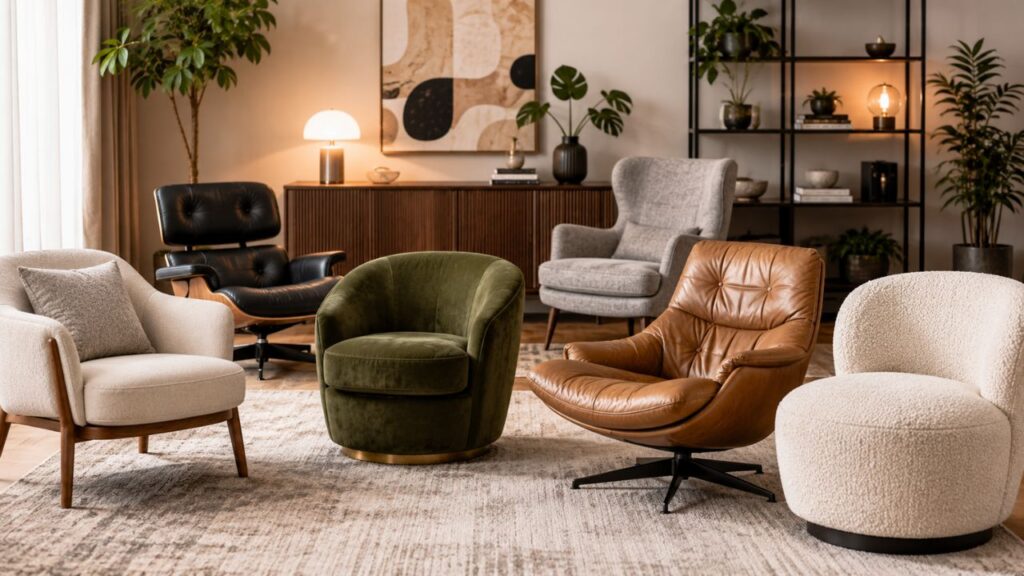
The term lounge chairs gets thrown around loosely. It covers everything from a stiff, upright club chair to a slouchy, floor-level meditation seat. Understanding the categories helps you shop with intention rather than just scrolling for “cute living room furniture.”
The Classic Club Chair. This is your archetypal comfortable armchair with thick rolled arms, a deep seat, and a relatively upright back. Originally designed for gentlemen’s clubs in Victorian London, the proportions assume a taller, broader frame. If you’re petite, many traditional club chairs will swallow you whole. Look for versions with a slightly shorter seat depth and a firmer cushion density if you actually want to get out of it without assistance.
The Mid-Century Modern Lounge Chair. This category exploded in the 1950s when designers like Charles and Ray Eames, Hans Wegner, and Arne Jacobsen started applying ergonomic science to residential furniture. The modern lounge chair isn’t just a style statement; it’s typically built around a molded shell that dictates a specific lounge chair angle. The Eames Lounge Chair and Ottoman, for instance, uses a 15-degree tilt on the backrest and a slightly forward-tilted seat pan that distributes weight between the sit bones and the upper back. If you’re searching for the best lounge chair in this category, pay attention to whether the shell is sized for your torso height. Many vintage originals were designed for average male proportions of the era, which can leave modern buyers feeling like Goldilocks in the wrong bed.
The Chaise and the Long Chair. The long chair design, popularized by Le Corbusier’s LC4, is essentially a sculpture you lie on. The lounge chair position here is fully reclined, with the legs elevated above the heart. This is peak relaxation for reading or napping but useless for conversation or working on a laptop. The lounge chair seat back angle comfort on a chaise is adjustable, often through a friction mechanism, which means you can fine-tune your angle throughout the afternoon. The tradeoff is footprint. A full chaise demands significant floor space.
The Swivel and the Sculptural Accent. Many unique accent chairs prioritize silhouette over sustained comfort, and that’s okay if you’re honest about their use case. A sculptural accent chair with a curved barrel back and no arms might be perfect for a cocktail party where people perch for fifteen minutes, but it’s a terrible choice for a bedroom sofa chair where you plan to read for two hours every night. I categorize these as “event seating,” not “daily seating.” Buy them for how they make the room feel, not for how they make your body feel.
The Anatomy of a Perfect Lounge Chair Angle
I want to drill deeper into lounge chair angles because this is the technical information that actually separates a good purchase from a chiropractor visit. When I measure a chair, I look at three specific numbers.
The seat pan tilt, measured relative to the floor, determines whether you slide forward or settle back. A neutral lounge seat sits between 5 and 10 degrees of backward tilt. Anything flatter feels unstable; anything steeper and you’re fighting gravity to stay upright. The backrest angle, measured relative to the seat pan, should land between 100 and 110 degrees for an active relaxation posture. Combine a 7-degree seat tilt with a 105-degree backrest angle, and you have a chair that supports both your spine and your conversation posture.
The third number is the angle between the seat front and the floor, often called the waterfall edge. A sharp, square front edge compresses the blood vessels under your thighs, leading to that tingly, “my leg fell asleep” sensation. A softened, downward-sloping edge distributes pressure more evenly. This detail is why some best lounge chairs feel weightless while others create hot spots. If you’re shopping online and can’t test sit, look for photos that show the chair in profile. A visible waterfall edge at the front of the seat cushion is a green flag.
I’ve applied these measurements to a worn-out vintage leisure chair I found at a flea market. The frame had the right angles—an 8-degree seat tilt and roughly a 105-degree backrest—but the foam had collapsed over forty years. A local upholsterer rebuilt the cushions with high-resilience foam at a 2.8-pound density, which is the commercial-grade sweet spot between softness and support. That chair, which cost me eighty dollars at the flea market and two hundred to reupholster, now outperforms designer lounge chairs I’ve tested that retail for four thousand dollars.
Comfort Geometry: A Comparative Look at Iconic Designs
| Chair Model | Seat Tilt | Backrest Angle (from seat) | Seat Depth | Best For |
|---|---|---|---|---|
| Eames Lounge Chair | 7° | 105° | 21.5″ | Reading, listening to music, classic mid-century aesthetic |
| Wegner GE 290 | 5° | 108° | 20.5″ | Petite-to-average frames, upright lounging, conversation |
| Le Corbusier LC4 | Variable (chaise) | Variable (adjustable) | Full body length | Napping, sunbathing, full recline relaxation |
| Strichap Shell Chair | 10° | 100° | 19″ | Compact spaces, brief seating, sculptural accent |
| Knoll Barcelona Chair | 3° | 98° | 21″ | Formal living rooms, aesthetic statement, short-term seating |
Case Study: The Living Room That Ate Three Chairs
A client of mine, a therapist who runs sessions from her home, went through three room chairs in eighteen months before calling me. The first was a stylish mid-century replica with a seat depth of 24 inches and virtually no lumbar support. Her clients, sitting for fifty-minute sessions, would start fidgeting at the thirty-minute mark. The second was an oversized comfortable chair for living room use that was genuinely pleasant but so wide it made her consulting room feel cramped and unbalanced. The third was a cheap bedroom chair design that looked fine online but arrived with foam so soft she could feel the frame through the cushion within a month.
We diagnosed the problem together. She needed a chair that could support a wide range of body types for nearly an hour at a time, had a neutral lounge chair position that worked for conversation, and was compact enough to not dominate the space. We landed on a Wegner-inspired modern lounge chair with an 8-degree seat tilt, a 108-degree backrest angle, and a seat depth of 21 inches. The armrests were wide and flat, perfect for resting a notebook. It wasn’t the flashiest chair in the catalog, but it solved the actual human problem. Six months later, she reported that clients stopped shifting around mid-session and occasionally didn’t want to get up at the end.
Material Honesty: What Holds Up Over Time
Fabric choices for accent chairs and room chair design pieces often come down to aesthetics, but durability is where the real comfort lives long-term. A chair that looks gorgeous in a showroom but pills, sags, or stains within a year is no longer a comfortable chair; it’s a source of low-grade annoyance every time you walk past it.
Performance velvet has become the default choice for unique accent chairs for good reason. It resists crushing, hides spills if you blot quickly, and has a depth of color that flat weaves can’t match. Leather, especially full-grain or top-grain aniline leather, develops a patina over time that actually improves the chair’s character. The tradeoff is temperature. Leather feels cool in winter and sticky in summer unless you’re in a climate-controlled environment.
For a comfortable armchair that gets daily use, I recommend solution-dyed acrylic fabrics like those from Sunbrella or Perennials. These were originally developed for outdoor furniture, but they’ve become popular for indoor lounge chairs because they’re bleach-cleanable, fade-resistant, and feel like soft cotton. I’ve seen a Sunbrella-covered bedroom sofa chair survive a toddler, a golden retriever, and a red wine incident without showing any evidence. That’s the kind of durability that keeps a chair comfortable psychologically; you stop worrying about it.
The Rise of the Bedroom Lounge Chair
A specific trend I’ve noticed in the past five years is the migration of the lounge chair into the bedroom. People are carving out reading corners, morning coffee spots, and “I need fifteen minutes alone before I deal with this household” retreats. The bedroom chair design category has expanded to include smaller-scale sofa chair design pieces that are wider than a standard armchair but narrower than a loveseat.
The bedroom sofa chair occupies an interesting niche. It needs to be compact enough to not block the flow of the room, comfortable enough for a two-hour reading session, and attractive enough that it doesn’t look like leftover living room furniture that got banished upstairs. My go-to recommendation for this category is a chair-and-a-half design with a single long cushion, sloped arms that you can lean against sideways, and a seat depth that allows you to curl your legs up. The lounge chair seat back angle comfort for a bedroom chair skews slightly more reclined, around 110 to 115 degrees, because the use case is relaxation rather than socializing.
When I’m helping someone select room chairs for a bedroom, I always ask about the morning routine. If this chair is where you’ll sit to put on socks and shoes, it needs a firmer seat and a higher seat height—around 18 to 19 inches from the floor. If it’s purely for reading and daydreaming, a lower seat height of 15 to 16 inches with a deeper recline creates that tucked-away, cocooning feeling that makes a bedroom feel like a sanctuary.
Famous Chairs That Earned Their Reputation
Some famous chairs are famous because they look striking in photographs. Others earned their place in design history because they solved comfort problems that no one had properly addressed before. The Eames Lounge Chair, introduced in 1956 by Herman Miller, isn’t just a status symbol. Charles Eames described the feeling he wanted as “the warm, receptive look of a well-used first baseman’s mitt.” The molded plywood shells cradle the body at specific angles that were revolutionary at the time. The separate lumbar and head cushions address the problem of varying torso lengths.
Hans Wegner’s GE 290, often called the “OX Chair,” is less visually famous but beloved by furniture nerds for its headrest angle. The headrest tilts forward just enough to support the occipital ridge without pushing the chin into the chest. It’s a subtle adjustment that makes a massive difference for tall people who often find headrests useless because they hit at the wrong point.
The Togo by Michel Ducaroy for Ligne Roset, introduced in 1973, looks like a squishy caterpillar. It has no internal frame. Five densities of foam are layered and shaped to create structure without wood or metal. The lounge chair angles are built into the foam carving itself, which means the chair conforms to the body rather than forcing the body to conform to it. The Togo divides opinions sharply. Some people find it the most comfortable lounge chair they’ve ever experienced. Others, particularly those with lower back issues that require firm support, find the frameless construction disorienting.
How to Actually Shop: A Process That Works
I’ve developed a testing protocol for evaluating comfortable chairs that goes beyond “sit for thirty seconds and decide.” When you’re in a showroom evaluating types of lounge chairs, bring a book. Sit in the chair in your natural reading position for at least ten minutes. Pay attention to where pressure builds. Your sit bones should feel evenly supported, not like they’re pressing into a hard spot. Your shoulder blades should rest against the backrest without hunching forward. Your feet should reach the floor without your thighs lifting off the seat cushion.
Notice what your hands naturally do. If the armrests are too low, your shoulders will creep up toward your ears. If they’re too high, your elbows will wing out awkwardly. The ideal armrest height allows your forearms to rest with your elbows at roughly a 90-degree bend and your shoulders relaxed. This detail is often overlooked in sofa chair design, where armrests are treated as decorative elements rather than functional supports.
If you’re shopping online for modern lounge chairs without the chance to test sit, measure a chair you already find comfortable and compare the numbers. Find the seat depth, seat height, and approximate backrest angle of your favorite seat. Use those as your baseline. When a product description doesn’t list seat depth, email the company and ask. The ones that won’t tell you are the ones hiding something.
FAQ Section
What makes a lounge chair genuinely comfortable for long periods?
The combination of a 100-110 degree backrest angle, adequate lumbar support that fills the curve of your lower back, a seat depth that matches your thigh length, and high-resilience foam that doesn’t bottom out. The most comfortable lounge chair supports your spine’s natural curves without forcing you into one rigid position.
How do I choose the right size lounge chair for my body?
Seat height and seat depth are your critical measurements. A comfortable chair for living room use should allow your feet to rest flat on the floor with your knees at roughly a 90-degree angle. The seat depth should leave two to three inches of space between the front edge and the back of your knees. If you’re tall, look for a higher backrest that supports your head.
Are expensive designer chairs actually more comfortable?
Sometimes, but not automatically. Many designer chairs and famous chairs earned their reputations through genuine ergonomic innovation. Others are primarily sculptural objects. Price correlates more with materials, brand prestige, and manufacturing complexity than with comfort. A well-designed leisure chair at a mid-range price point can outperform a luxury piece that prioritizes form.
What’s the best type of lounge chair for a small living room?
A compact unique accent chair with a swivel base maximizes function in a small footprint. Look for room chair design options with a seat depth under 22 inches and a relatively upright backrest angle of around 100 degrees. These feel comfortable for conversation without demanding excessive floor space.
Can a lounge chair work in a bedroom?
Absolutely. A bedroom sofa chair or bedroom chair design piece creates a functional zone separate from the bed. The best comfortable chairs for living room spaces often work equally well in bedrooms, though bedroom chairs can lean slightly more reclined since the context is pure relaxation rather than social entertaining.
How do I maintain the comfort of my lounge chair over time?
Rotate and flip cushions if the design allows. Vacuum fabric regularly to prevent dust from abrading the fibers. For foam-filled lounge chairs, re-plump the cushions after heavy use. If the foam begins to sag after years of use, a reupholstery service can replace the internal foam, often at a fraction of the cost of a new chair.