Few pieces of furniture punch above their weight the way a pouf does. It’s small enough to tuck under a coffee table, light enough to move from room to room in seconds, and versatile enough to function as extra seating, a footrest, a side table, or a purely decorative accent — sometimes all in the same afternoon. If you’ve been underestimating what this compact piece can do for your home, this guide will change that.
The renewed interest in flexible, multi-functional furniture has pushed poufs back into the spotlight in a significant way. Interior designers who once reserved them for bohemian or globally-inspired spaces now recommend them across virtually every style category — from minimalist Scandinavian rooms to traditional American living rooms. The reason is simple: they solve real problems without taking up much space or budget.
Choosing the right one, though, takes more thought than most people expect. Material, fill, size, shape, and style all affect how a pouf performs in your specific space. Get those decisions right, and you’ll wonder how you ever managed without one. Get them wrong, and you’ll end up with something that looks great in the store but never quite works at home.
What Exactly Is a Pouf and Where Did It Come From?
The word “pouf” comes from French, where it originally described a large, heavily padded hairstyle popular in eighteenth-century aristocratic circles — think Marie Antoinette. The furniture piece borrowed the name because of its similarly rounded, cushioned form. By the nineteenth century, the term had migrated firmly into the world of interior furnishings.
Historically, the pouf as a furniture piece has roots in North African and Middle Eastern design traditions, where floor-level seating and low, cushioned stools were central to domestic life. Moroccan leather poufs — hand-stitched, stuffed with recycled textiles, and dyed in rich jewel tones — remain one of the most recognizable and widely exported versions of the form. Their popularity in Western interiors from the 1990s onward helped establish the pouf as a mainstream furniture category rather than an exotic import.
How a Pouf Differs from Other Seating Accessories
The terminology around low, cushioned seating accessories can get confusing, so it’s worth clarifying the distinctions. A pouf ottoman is essentially the same thing — “ottoman” is the broader American term for any upholstered, backless seating or footrest piece, while “pouf” typically implies a softer, more rounded, less structured form.
A foot stool is generally smaller and lower than a pouf, designed primarily for resting feet rather than providing seating. Poofs — an alternate spelling you’ll encounter frequently — refer to exactly the same piece as a pouf; the spelling varies by retailer and region but describes identical products. A pouf chair is a slightly different category: a larger, more structured version designed primarily for sitting rather than as a footrest or accent piece.
The Many Ways to Use Poufs in Your Home
The genuine appeal of poufs lies in their flexibility. Unlike most furniture, which has one fixed purpose and one fixed location, a pouf adapts to whatever the room needs at any given moment. That adaptability is particularly valuable in smaller homes and apartments where every piece needs to earn its place.
Here are the most practical and popular ways people actually use them:
- Extra seating — when guests arrive and you need another seat quickly, a pouf provides comfortable, casual seating without the permanence of an additional chair
- Footrest — paired with a sofa or armchair, a pouf ottoman serves as a comfortable leg rest that you can push aside when you don’t need it
- Coffee table alternative — a firm, flat-topped pouf with a tray on top functions as a soft coffee table, particularly useful in homes with young children where hard edges are a concern
- Bedside accent — at the foot of a bed or beside a nightstand, a pouf adds texture and a landing spot for clothes or bags
- Reading nook companion — next to a floor lamp and a comfortable chair, a pouf creates an instant reading corner
- Children’s room seating — low, soft, and lightweight, poufs are ideal for kids’ rooms where floor-level play is the norm
The key insight is that a pouf doesn’t need a permanent assignment. Its value comes precisely from the fact that it can move and adapt.
Pouf Materials: What to Choose and Why It Matters
Material choice affects everything — how the pouf looks, how it feels underfoot, how it holds its shape over time, and how easy it is to clean. This is where many buyers make their first mistake, choosing based on appearance alone without considering the practical demands of their specific household.
Leather and Faux Leather Poufs
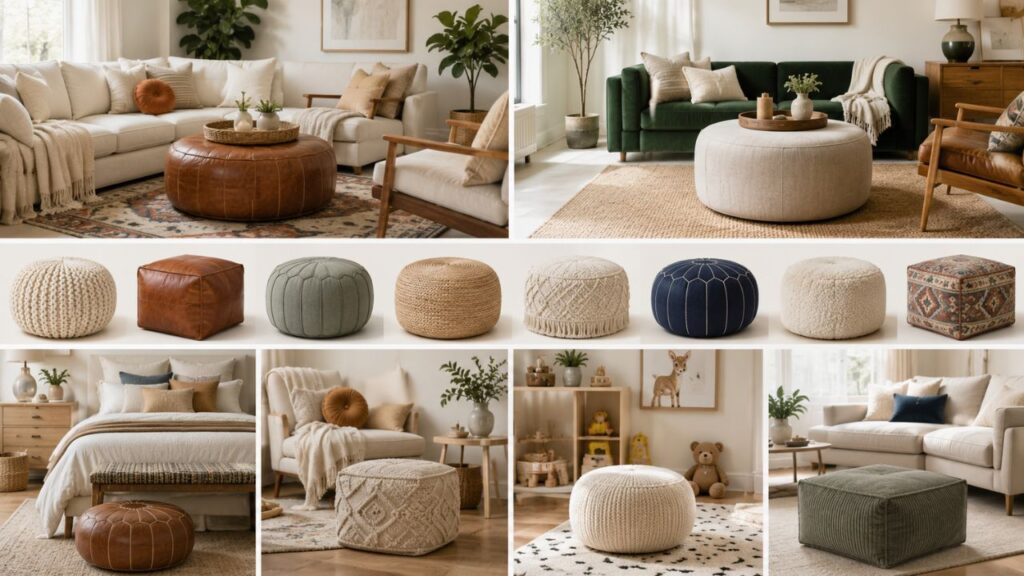
Genuine leather poufs — particularly the hand-stitched Moroccan variety — are among the most durable options available. A well-made leather pouf can last decades with minimal care, developing a beautiful patina over time. The trade-off is cost: authentic leather poufs from quality sources typically run $80 to $200 or more, depending on size and craftsmanship.
Faux leather offers a similar aesthetic at a lower price point and is often easier to clean, making it a practical choice for households with children or pets. The longevity doesn’t match genuine leather, but for most buyers, the value proposition is strong.
Knit and Woven Fabric Poufs
Chunky knit poufs have become one of the most popular categories in recent years, driven by the broader trend toward cozy, textured interiors. They add warmth and visual softness to a room in a way that leather and structured fabrics can’t replicate. The trade-off is durability — knit poufs tend to snag, pill, and lose their shape more quickly than other materials, particularly in high-traffic areas.
Woven fabric poufs in cotton, jute, or wool offer a middle ground: more texture and warmth than leather, more durability than knit. Jute poufs in particular have become a staple of coastal and bohemian interiors, and they hold up well to regular use.
Velvet and Upholstered Poufs
Velvet poufs bring a richness and formality that works beautifully in more traditional or maximalist interiors. They’re softer underfoot than leather and more visually luxurious than fabric. The practical challenge is maintenance — velvet attracts pet hair and can be difficult to clean if spills occur. In a household without pets and with careful use, a velvet pouf ottoman can be a genuinely elegant addition.
Understanding Pouf Fill: What’s Inside Matters
The fill material determines how a pouf feels to sit on, how well it holds its shape, and how it performs over time. This is one of the most overlooked aspects of pouf selection, and it’s worth understanding before you buy.
EPS bead fill (expanded polystyrene beads) is the most common fill for softer, more casual poufs. It’s lightweight, comfortable, and conforms to the body when you sit on it. The downside is that EPS beads compress over time and may need to be topped up or replaced after a few years of regular use.
Recycled textile fill is traditional in Moroccan leather poufs and many handcrafted versions. It’s dense, firm, and extremely durable — these poufs hold their shape well and can support significant weight. The firmness makes them better as foot stools or side tables than as primary seating for extended periods.
Foam fill produces a firmer, more structured pouf that holds its shape consistently. Foam-filled poufs tend to work better as pouf chair alternatives — pieces designed for actual sitting rather than occasional use.
Hollow or unfilled poufs are sold flat and require you to source your own fill — typically old clothes, blankets, or purchased stuffing. They’re the most affordable option and allow you to control the firmness, but the filling process takes time and the result depends heavily on what you use.
Choosing the Right Size and Shape for Your Space
Size and shape are the two decisions that most directly affect whether a pouf works in your specific room. Getting either wrong creates a piece that looks out of proportion or simply doesn’t function the way you intended.
Standard Pouf Dimensions
Most poufs fall within a fairly predictable size range:
- Small poufs — approximately 12 to 14 inches in diameter and 8 to 10 inches tall; best as decorative accents or children’s seating
- Standard poufs — approximately 18 to 20 inches in diameter and 12 to 14 inches tall; the most versatile size for adult footrest use
- Large poufs — approximately 24 to 26 inches in diameter and 14 to 18 inches tall; suitable as primary seating or coffee table alternatives
For use as a foot stool alongside a standard sofa, a height of 12 to 14 inches typically aligns well with sofa seat height. For use as a pouf chair for actual sitting, look for pieces at least 16 inches tall to ensure comfortable posture.
Round vs. Square vs. Cylindrical
Round poufs are the most common and the most versatile — their lack of corners makes them easy to move around and less likely to create visual clutter. Square or rectangular poufs have a more structured, architectural quality that suits contemporary and minimalist interiors. Cylindrical poufs — taller and narrower than standard round versions — work well as side tables or accent pieces in corners.
Styling Poufs Across Different Interior Aesthetics
One of the reasons poufs have maintained such broad appeal is their adaptability across interior styles. The same basic form — a low, cushioned, backless seat — can read as bohemian, coastal, contemporary, or traditional depending entirely on the material, color, and context.
Bohemian and Global-Inspired Interiors
This is the natural home territory for poufs, particularly the Moroccan leather variety. In a boho-inspired living room, a cluster of poufs in different sizes and colors creates an inviting, layered seating arrangement that feels relaxed and well-traveled. Pair with kilim rugs, macramé wall hangings, and plenty of plants for maximum effect.
Minimalist and Scandinavian Spaces
In a minimalist interior, a single, well-chosen pouf ottoman in a neutral tone — natural linen, undyed wool, or matte leather — adds warmth and a human scale without disrupting the visual calm. The key is restraint: one pouf, chosen carefully, rather than a collection.
Traditional and Classic Interiors
Velvet or tufted fabric poufs in rich colors — burgundy, navy, forest green — translate beautifully into traditional spaces. Paired with a wingback chair or a Chesterfield sofa, a well-upholstered pouf feels like a natural extension of the room’s existing vocabulary rather than an imported trend.
Contemporary and Transitional Rooms
Geometric shapes, clean lines, and solid colors work best in contemporary spaces. A square or cylindrical pouf in a textured fabric — boucle, for example — adds tactile interest without competing with the room’s architectural clarity.
Caring for and Maintaining Your Poufs
The longevity of any pouf depends significantly on how you care for it. The good news is that most poufs are relatively low-maintenance — but the specific care approach varies by material.
Leather poufs benefit from occasional conditioning with a leather conditioner to prevent cracking and maintain suppleness. Wipe spills immediately with a dry cloth, and avoid prolonged exposure to direct sunlight, which can fade and dry out the leather over time.
Fabric and knit poufs should be spot-cleaned with a mild detergent and cold water for most stains. Many fabric-covered poufs have removable covers that can be machine washed — check the care label before purchasing if this matters to you. Knit poufs benefit from occasional reshaping by hand to maintain their form.
Jute and natural fiber poufs are the most sensitive to moisture. Keep them away from damp areas and clean with a dry brush rather than wet cloths where possible. A light vacuuming every few weeks prevents dust from embedding in the fibers.
For any pouf that loses its shape over time, the fix is usually straightforward: add more fill, redistribute existing fill, or replace compressed EPS beads with fresh ones. Most quality poufs are designed with this in mind, featuring zippered openings that make refilling easy.
Frequently Asked Questions
How much weight can a pouf typically support?
Weight capacity varies significantly by fill type and construction. A densely filled leather pouf with recycled textile fill can typically support 200 to 300 pounds comfortably. EPS bead-filled poufs are generally rated for 150 to 200 pounds. Always check the manufacturer’s weight rating before using a pouf as primary seating, particularly for heavier adults or children who might jump on it.
Are poufs suitable for outdoor use?
Most standard poufs are designed for indoor use only, as their materials — leather, fabric, knit — don’t handle moisture or UV exposure well. However, a growing number of manufacturers produce outdoor-specific poufs in weather-resistant materials like solution-dyed acrylic fabric or UV-stabilized synthetic leather. If you want a pouf for a covered patio or sunroom, look specifically for products labeled as outdoor or weather-resistant.
Can I use a pouf as a primary seat at a dining table?
Poufs aren’t well-suited to dining table use in most cases. Their height is typically lower than standard dining chair height, and their lack of back support makes extended seated meals uncomfortable. They work much better as casual seating in living rooms, reading nooks, or children’s spaces where posture demands are lower and the duration of sitting is shorter.
How do I stop a pouf from sliding on hardwood floors?
A non-slip rug pad cut to size and placed under the pouf is the most effective solution. Alternatively, self-adhesive felt pads applied to the base of the pouf reduce sliding while also protecting your floor finish. Some poufs come with a non-slip base already integrated — worth checking before purchasing if floor protection is a priority.
What’s the best pouf size for a small apartment?
For small spaces, a standard-size round pouf — approximately 18 inches in diameter and 12 to 14 inches tall — offers the best balance of functionality and footprint. It’s large enough to use comfortably as a footrest or occasional seat, but small enough to tuck under a coffee table or into a corner when not in use. Avoid oversized poufs in small rooms, as they tend to dominate the space visually and physically.
Can poufs be used safely around young children and toddlers?
Poufs are generally one of the safer furniture options for homes with young children. Their low height means falls are minor, their soft construction eliminates hard edges, and their lightweight nature means they don’t pose a tipping hazard. The main consideration is fill type — EPS bead-filled poufs should have secure, child-proof zippers to prevent access to the beads, which are a choking hazard for very young children.
How do I choose between a pouf and a traditional ottoman?
The choice comes down to structure and formality. A traditional ottoman tends to be more structured, more formal, and more permanently positioned — it’s a piece of furniture with a fixed role. A pouf is softer, more casual, and more mobile — it’s a flexible accessory that adapts to different needs. If you want something that anchors a seating arrangement and doubles as a coffee table, a structured ottoman may serve you better. If you want something you can move freely and use in multiple ways, a pouf is the more versatile choice.
The Small Piece That Makes a Big Difference
There’s a reason experienced interior designers almost always include at least one pouf in their living room plans. It’s not because they’re following a trend — it’s because a well-chosen pouf genuinely improves how a room functions and feels. It adds a layer of flexibility that fixed furniture simply can’t provide, and it does so without demanding much space, budget, or commitment.
The range of options available today — from hand-stitched Moroccan leather to chunky knit, from velvet to jute, from tiny accent pieces to large pouf chair alternatives — means there’s a version that works for virtually every home, every style, and every budget. The key is understanding what you actually need from the piece before you buy, rather than choosing based on appearance alone.
A pouf that’s right for your space will earn its place every single day — moved from room to room, pressed into service as a footrest one moment and extra seating the next, quietly making your home more comfortable and more adaptable. That’s a lot to ask of something so small, and it’s exactly what the best ones deliver.